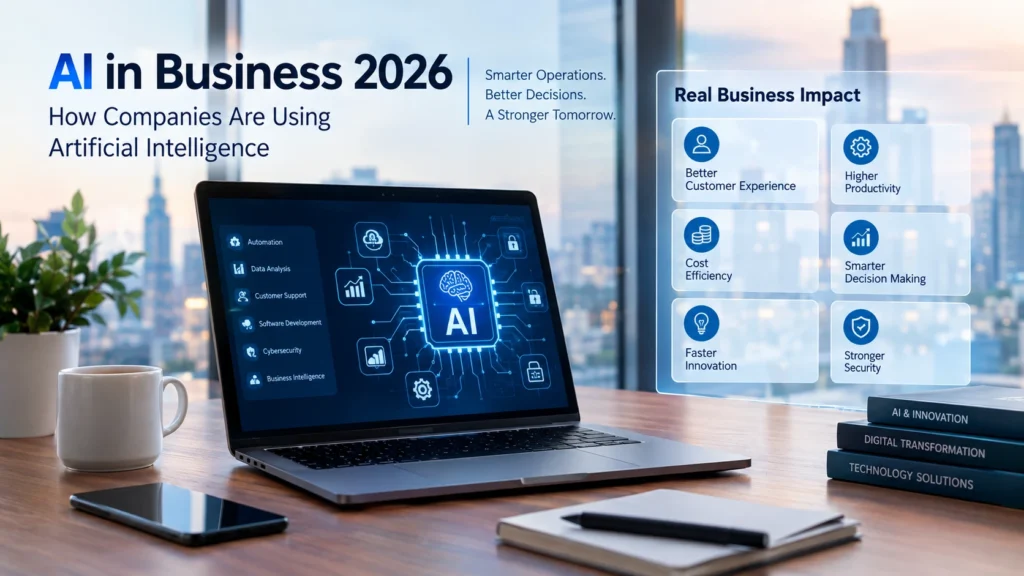
Artificial intelligence has moved from being an experimental technology to becoming part of everyday business operations. Companies are using AI to analyze information, automate repetitive work, improve customer experiences, support employees, develop software, detect risks and make faster decisions.
In 2026, the conversation around AI is also changing. Businesses are no longer asking only, “What can AI do?” They are increasingly asking, “Where can AI create measurable business value, and how can we implement it responsibly?”
Recent McKinsey research shows that nearly nine in ten surveyed organizations reported using AI in at least one business function in 2026, while 44% reported that AI was scaling across their enterprise. At the same time, the research highlights an important challenge: widespread usage does not automatically translate into enterprise-level financial impact.
For businesses, this makes 2026 an important year for moving from AI experimentation toward practical implementation.
AI Business Map: What This Guide Covers
| Business Area | What You Will Learn |
|---|---|
| AI fundamentals | What AI means for modern businesses |
| Business applications | Where companies are using AI |
| Customer experience | How AI supports customers and sales |
| Operations | How businesses automate repetitive processes |
| Software & IT | How AI is changing development and IT |
| Data & decisions | How AI supports analysis and forecasting |
| Workforce | How employees can work alongside AI |
| Risks | Security, privacy, accuracy and governance concerns |
| Implementation | How companies can begin an AI initiative |
| Future direction | What businesses should prepare for next |
What Is AI in Business?
AI in business refers to the use of artificial intelligence technologies to perform or support tasks that traditionally require human judgment, analysis, pattern recognition, language understanding or decision-making.
Depending on the application, AI can help a company:
- Analyze large amounts of data
- Generate and summarize information
- Answer customer questions
- Detect unusual activity
- Automate repetitive workflows
- Assist software developers
- Forecast demand
- Personalize customer interactions
- Extract information from documents
- Support employees with research and knowledge retrieval
AI does not necessarily mean replacing an entire business process with machines. In many practical implementations, AI works as a support layer that helps people complete tasks faster or make better-informed decisions.
This distinction is important because successful AI adoption usually involves changes to workflows, data, technology and employee practices—not simply installing an AI tool.
Why AI Has Become Important for Businesses in 2026
AI adoption has expanded significantly across industries.
McKinsey’s 2026 global AI survey reports that organizations are moving beyond isolated experimentation, with AI being used across more business functions and increasingly integrated into enterprise workflows. The survey also found that 40% of respondents from large organizations reported scaling AI agents, compared with 22% from smaller organizations.
India’s technology-services landscape is also being reshaped by AI. A 2026 NITI Aayog technology-services roadmap describes AI as a major disruption to traditional technology-service delivery and highlights opportunities around AI integration, model engineering, data infrastructure and governance.
This means businesses are increasingly evaluating AI not simply as a technology trend, but as part of their broader technology strategy.
10 Major Ways Companies Are Using AI
1. AI for Customer Support
Customer service is one of the most visible applications of AI.
Businesses can use AI-powered systems to:
- Answer frequently asked questions
- Provide 24/7 initial support
- Route customer requests
- Summarize conversations
- Search internal knowledge bases
- Assist human support agents
- Classify incoming requests
For example, an AI support assistant can understand a customer’s question, retrieve relevant information from an approved knowledge base and provide an initial response.
For complex issues, the conversation can be transferred to a human employee.
The objective is not necessarily to eliminate human support. A better approach can be to let AI handle repetitive questions while employees concentrate on cases requiring judgment, empathy or specialized knowledge.
2. AI in Marketing and Sales
Marketing and sales teams are using AI to analyze customer information, create content drafts, identify patterns and support personalization.
Common applications include:
- Customer segmentation
- Lead scoring
- Content assistance
- Campaign analysis
- Product recommendations
- Sales forecasting
- Customer sentiment analysis
- Personalized communication
McKinsey’s research has consistently identified marketing and sales among the business functions where generative AI is widely used.
However, businesses should not treat AI-generated marketing content as automatically accurate or effective. Human review remains important for brand voice, factual accuracy, compliance and customer communication.
3. AI for Business Data Analysis
Modern businesses generate information from websites, applications, transactions, customer interactions, marketing platforms and internal systems.
The challenge is often not collecting data—it is turning that data into useful information.
AI can support data analysis by helping organizations:
- Identify patterns
- Summarize datasets
- Detect anomalies
- Generate natural-language explanations
- Assist forecasting
- Categorize information
- Support business intelligence workflows
For example, instead of manually reviewing thousands of customer records, an AI-assisted analytics system could identify common complaints, unusual patterns or changes in customer behavior.
AI does not replace the need for good data. Poor-quality, incomplete or biased data can produce unreliable results.
4. AI in Software Development
Software development is another area experiencing significant AI adoption.
AI-powered development tools can assist programmers with:
- Code generation
- Code explanation
- Debugging
- Documentation
- Test creation
- Code transformation
- Development research
- Repetitive programming tasks
The role of the developer is therefore changing.
Instead of manually writing every line of code, developers can increasingly use AI as a development assistant while focusing more attention on architecture, requirements, security, testing, integration and product decisions.
McKinsey’s 2026 research reports growing adoption of agentic coding tools, including organizations using them to build software internally rather than purchasing some software products or features.
AI-assisted development still requires professional review. Generated code can contain security issues, incorrect assumptions, performance problems or licensing concerns.
5. AI for Business Process Automation
Many organizations contain repetitive processes that involve moving information from one system to another, reviewing documents or responding to standard requests.
AI can make automation more flexible by combining traditional workflow automation with language and reasoning capabilities.
Examples include:
Invoice → AI extracts information → System validates data → Employee approves → Accounting system is updated
Other examples include:
- Document processing
- Email classification
- Customer onboarding
- Internal request routing
- Report generation
- Employee knowledge assistance
- Appointment processing
- Data entry support
The biggest opportunity is often found by examining the entire workflow rather than automating a single isolated task.
6. AI in Cybersecurity
As businesses become increasingly digital, cybersecurity becomes an important part of AI implementation.
AI can support security teams by helping with:
- Threat detection
- Anomaly identification
- Log analysis
- Alert prioritization
- Security monitoring
- Phishing detection
- Incident investigation
At the same time, AI introduces new security challenges.
Businesses need to consider:
- Sensitive information entering AI systems
- Unauthorized access
- Prompt injection
- Model manipulation
- Data leakage
- AI-generated phishing
- Third-party AI service risks
Therefore, AI adoption and cybersecurity should not be treated as separate conversations.
7. AI for Human Resources
HR departments can use AI for selected administrative and analytical activities.
Possible applications include:
- Resume screening assistance
- Employee FAQ systems
- Job-description drafting
- Learning recommendations
- Workforce analytics
- Employee onboarding assistance
- Internal knowledge search
However, HR is a sensitive area.
AI systems should not be treated as unquestionable decision-makers for employment-related decisions. Organizations need appropriate human oversight, fairness checks, privacy controls and clear processes for reviewing automated recommendations.
8. AI for Finance and Risk Management
Financial teams can use AI to support information processing and analysis.
Potential applications include:
- Expense categorization
- Financial document processing
- Fraud detection
- Forecasting
- Transaction monitoring
- Financial reporting assistance
- Risk analysis
AI can help identify patterns that deserve human attention, but organizations should carefully control automated decisions where financial, legal or regulatory consequences are significant.
9. AI in Product and Service Development
AI can help organizations understand customer feedback and identify opportunities for new products or improvements.
Businesses can analyze:
- Customer reviews
- Support tickets
- Survey responses
- Product usage data
- Market information
- Competitor information
This can help product teams identify recurring customer problems.
Generative AI is also being used in product and service development, one of the areas highlighted in McKinsey’s research on enterprise gen-AI adoption.
10. AI-Powered Knowledge Management
Large organizations often have valuable information spread across documents, emails, knowledge bases, manuals and internal applications.
Finding the right information can take significant employee time.
AI-powered knowledge systems can allow employees to ask questions in natural language and retrieve relevant information from approved company sources.
For example:
“What is our standard process for handling this type of customer request?”
Instead of searching through multiple documents, an employee may receive an AI-assisted answer based on the organization’s internal knowledge.
The quality of such systems depends heavily on the quality, permissions and freshness of the underlying information.
Generative AI vs Traditional AI in Business
Not every AI application is generative AI.
Traditional AI systems are commonly used for tasks such as prediction, classification, recommendation and anomaly detection.
Generative AI focuses on creating new content such as:
- Text
- Code
- Images
- Audio
- Video
- Summaries
A business may use both.
| Traditional AI | Generative AI |
|---|---|
| Fraud detection | Report generation |
| Demand forecasting | Marketing copy drafts |
| Recommendation systems | Content creation |
| Customer classification | Conversational assistants |
| Anomaly detection | Code generation |
| Predictive analytics | Document summarization |
A mature AI strategy should therefore focus on business problems first, rather than assuming every problem requires generative AI.
AI Agents: The Next Stage of Business Automation
One of the major developments in 2026 is the growing interest in AI agents.
A traditional AI assistant may respond to a request.
An AI agent can potentially perform multiple steps toward a defined objective by interacting with tools, data and business systems.
For example:
Customer request
↓
AI agent identifies the issue
↓
Checks approved customer information
↓
Retrieves relevant policy
↓
Creates a proposed response
↓
Updates an authorized system
↓
Escalates when human approval is required
This is more complex than a simple chatbot.
McKinsey’s 2026 research reports increasing use of agentic AI, although scaling remains more advanced among large organizations than smaller organizations.
Businesses considering agents should begin with clearly defined workflows, permissions, monitoring and human-approval mechanisms.
What Benefits Can AI Bring to a Business?
AI can potentially create value in several areas.
Productivity
AI can reduce the time employees spend on repetitive activities.
Faster information access
Employees can search and summarize large amounts of information more quickly.
Better customer experiences
AI can provide faster responses and personalized interactions.
Operational efficiency
AI can help automate selected business processes.
Decision support
AI can identify patterns and provide analytical assistance.
Product innovation
Companies can use AI to create new products, features and services.
But these benefits should be measured rather than assumed.
McKinsey’s 2026 survey found that eight in ten respondents said AI had improved their own productivity, while reported organization-level EBIT impact remained much less widespread.
This illustrates an important lesson:
Employee productivity improvement is not automatically the same as business-level value.
The Biggest Challenges of Using AI in Business
AI implementation also comes with risks.
1. Data Privacy
Businesses may process confidential customer, employee or company information.
Before using an AI tool, organizations should understand:
- What data is being processed?
- Where is it stored?
- Who can access it?
- Is it used for model training?
- What security controls exist?
2. Incorrect AI Outputs
Generative AI can produce convincing but incorrect information.
Businesses should therefore establish review processes for important outputs.
3. Security Risks
AI applications can introduce new attack surfaces and data-security concerns.
Security testing should be part of the implementation process.
4. Integration Problems
An AI tool that works well in isolation may provide limited value if it cannot connect appropriately with existing business systems.
Integration planning is therefore important.
5. Employee Adoption
Technology alone does not create transformation.
Employees need training, clear guidelines and an understanding of how AI fits into their work.
6. Cost
AI systems can involve expenses related to:
- Software
- APIs
- Cloud infrastructure
- Data preparation
- Integration
- Security
- Monitoring
- Employee training
Businesses should compare these costs with measurable business outcomes
AI Governance: An Essential Part of Business AI
As AI becomes more deeply integrated into business operations, governance becomes increasingly important.
An AI governance framework can define:
- Which AI tools employees may use
- What information may be entered
- Who can approve AI applications
- How outputs are reviewed
- How AI systems are monitored
- How incidents are reported
- How vendors are evaluated
Regulation is also developing internationally. For example, the European Union’s AI Act uses a risk-based framework and introduces different requirements depending on the type and use of an AI system.
Businesses operating internationally should therefore consider applicable regulations before deploying AI in sensitive use cases.
How a Business Can Start Using AI
Companies do not need to transform every department at once.
A practical approach is to begin with a clearly defined business problem.
Step 1: Identify a Business Problem
Instead of asking:|
“Where can we use AI?
Ask:
“Which business process is slow, repetitive, expensive or difficult to manage?”
Step 2: Evaluate the Data
Determine whether the required information is:
- Available
- Accurate
- Structured
- Secure
- Legally usable
Step 3: Select the Right AI Approach
Depending on the problem, the solution might be:
- Traditional machine learning
- Generative AI
- AI-assisted analytics
- Automation
- An AI agent
- A combination of technologies
Step 4: Start With a Controlled Pilot
Test the solution with a limited workflow before expanding it across the organization.
Step 5: Define Success Metrics
Possible measurements include:
- Processing time
- Cost per transaction
- Response time
- Error rate
- Customer satisfaction
- Employee productivity
- Conversion rate
Step 6: Add Human Oversight
Important decisions should have appropriate human review.
Step 7: Scale Carefully
Once a pilot demonstrates value, organizations can improve the workflow, strengthen security and gradually expand deployment.
A Simple AI Readiness Checklist
Before implementing an AI solution, businesses can ask:
| Question | Why It Matters |
|---|---|
| What problem are we solving? | Prevents technology-first decisions |
| What data will AI require? | Determines feasibility |
| Is the data reliable? | Poor data can produce poor results |
| What systems must AI connect with? | Identifies integration requirements |
| What could go wrong? | Helps identify risk |
| Who reviews important outputs? | Creates accountability |
| How will success be measured? | Establishes ROI criteria |
| What security controls are required? | Protects company information |
| Do employees need training? | Improves adoption |
| Can the solution scale? | Supports long-term value |
The Future of AI in Business
The next phase of business AI is likely to involve more deeply integrated systems rather than isolated chatbots and individual productivity tools.
Companies are exploring AI that can work across workflows, connect with enterprise applications, assist employees and perform multiple steps toward business objectives.
However, the future of AI will not simply be about having the most advanced model.
Businesses will increasingly need to focus on:
AI + Data + Software + Security + People + Processes + Governance
NITI Aayog’s 2026 technology-services roadmap similarly points toward a shift from traditional service delivery toward AI-driven automation, platforms, data and outcome-oriented technology services.
This means companies that build strong digital foundations today may be better positioned to adopt increasingly capable AI systems.
AI and the Changing IT Services Industry
AI is also changing the role of IT service providers.
Traditional IT services often focused on implementation, maintenance and support.
The emerging model increasingly includes:
- AI integration
- Data engineering
- AI application development
- Automation
- Cloud infrastructure
- Cybersecurity
- AI governance
- Software modernization
- AI-enabled business processes
For an IT services company, this creates an opportunity to help businesses move from technology experimentation to practical implementation.
The value of an IT partner is therefore not simply providing access to an AI tool. It can include understanding the business requirement, selecting appropriate technology, integrating systems, securing data, measuring outcomes and maintaining the solution.
AI Skills Are Also Becoming Important for Freshers
The growth of business AI is creating demand for people who understand both technology and practical business applications.
Students and freshers can begin developing skills in areas such as:
- Python
- Data analytics
- Machine learning
- Generative AI
- Prompt engineering
- APIs
- Cloud computing
- Databases
- Software development
- Cybersecurity
- Power BI
- AI application development
Practical projects are particularly useful because they allow learners to understand how technologies work outside a purely academic environment.
For IT companies that provide internship programs, AI-related projects can also create a bridge between learning and real-world technology development.
Frequently Asked Questions
Is AI useful for small businesses?
Yes. Small businesses can use AI for customer support, marketing assistance, document processing, analytics, workflow automation and other targeted activities. The appropriate use case depends on the company’s requirements, data and budget.
Will AI replace IT jobs?
AI is changing the tasks performed in many technology roles, particularly repetitive activities. At the same time, organizations need people who can design, integrate, monitor, secure and manage AI-enabled systems. The impact will vary considerably by role and industry.
How much does business AI implementation cost?
There is no single cost. Expenses depend on the AI model or platform, data requirements, integrations, infrastructure, security, development effort and ongoing usage.
Should every business use generative AI?
Not necessarily. Businesses should first identify a genuine problem and then determine whether generative AI is an appropriate solution.
What is the difference between AI and automation?
Traditional automation generally follows predefined rules. AI can handle more complex tasks involving prediction, classification, language or pattern recognition. Many modern business solutions combine automation and AI.
What is an AI agent?
An AI agent is a system designed to perform multiple steps toward a goal, often by using tools, data or connected applications. Agentic systems are becoming an important area of enterprise AI development, although organizations still face challenges in scaling them safely and effectively.
Conclusion: AI Should Solve Business Problems, Not Just Create Hype
Artificial intelligence is becoming an important part of modern business technology. Companies are already using AI across customer service, marketing, software development, analytics, cybersecurity, operations, finance and knowledge management.
But successful AI adoption is not simply about choosing a powerful AI model.
The more important questions are:
What problem are we solving?
What value can the solution create?
Is our data ready?
How will we protect sensitive information?
How will employees work with the technology?
How will we measure the result?
In 2026, businesses are increasingly moving from AI experimentation toward implementation and scale. The organizations that approach AI strategically—combining technology with strong data, security, people, processes and governance—can build a more sustainable foundation for future digital transformation.
For IT service providers, this shift creates an opportunity to help businesses understand AI in practical terms and turn emerging technologies into useful, secure and measurable solutions.
AI is no longer simply a technology topic. For many businesses, it is becoming part of the broader strategy for how they build, operate and serve customers.